
STOW Test pits may 2026


According to the display in Stow Minster, it’s almost 180 years since the visit of a “class of men calling themselves archaeologists”, whose “pursuit of the luxurious and refined pleasures of the wealthy” were described as “criminal” by the parishioners of Stow. We found the current residents to be much more supportive and appreciative of our efforts. LAG members have really enjoyed their luxurious pleasures in Stow, although some might say that kneeling on the ground with a small trowel to move large quantities of soil is far from refined!
We dug four test pits on Church Road and these are the reports from each one plus a report from the finds processing group.
Thanks to Ian, Leon, Jacky, Jane and Jill for agreeing to record their experiences and to David and Jane for the photos.
Test Pit 1 - Ian
Well, it's finally here! My first archaeological dig after many years of watching Time Team,
Digging for Britain and let’s face it any history related TV show, I finally get to put my newly acquired trowel in the soil. My excitement is only exceeded by the strength of the sun, on what is going to be a scorching Bank Holiday weekend, and I am relieved to see that I have been allocated Test Pit 1 under the shade of a canopy of mature trees, although feeling a twinge of apprehension over the plethora of roots that may be present.

Teamed up with Nigel, Sue and Dave, all experienced diggers I was welcomed as the newbie, and wholly reliant on their experience, knowledge and guidance. My huge thanks to them for making the me feel part of a team effort and sharing some enjoyable conversation as we worked.
Having agreed our target location and set aside what could loosely be described as ‘turf’ or more accurately ‘weeds and leaf litter’ we started to scrape down. Within a few centimetres we soon started to see a change in the soil as a significant scatter of loose gravel appeared. As this seemed to be a change in strata we called in Martin for expert guidance who correctly assessed we were coming down onto a gravel paved surface which needed recording as different to the previous layer, or context to give it its proper name!
Thankfully Sue had volunteered to fill in the paperwork, as I was soon to discovery there is
loads of the stuff – even on a 1m x 1m pit. Every conceivable detail recorded; colour – greyish brown or brownish grey? (don’t get me started or we’ll have to resort to the Dulux colour or McVitees Biscuit charts) composition, compaction (generally hard or very hard), inclusions to name but a few and obviously measurements. There seemed to be far too much, but in reality an excavation is a once only event and for any future interpretation, by minds greater than mine, as much detail as possible needs to be available.

We continued digging and recording through the various layers; gravel paving, hardcore sub-base and subsoil so by the end of the first day we had dug about a foot – far less that I had expected (typical novice) but I hadn’t factored the hardness of the digging, the reams of paperwork and the oh so many roots.
Far from disheartened we were back the next day for more and carried on in the same vein until we exposed some stones cutting the corner of the trench that appeared flat, as though purposefully placed and with a defined straight edge. My imagination went into overdrive in true Time Team fashion and before long I had a shortlist of robber trench, wall foundation, boundary ditch and moat, stopping before I got to Roman temple.

A surprise lunch followed, provided by David and Claudia in their garden that was much appreciated by all (and apparently not standard dig procedure).
After lunch, Martin was once again summoned and suggested it to be just a backfill layer, but to draw it in case it proved otherwise – it didn’t, he was right again and having removed the single layer we were down to natural clay. A good point to clean up the excavation and close day 2
The final day was recording and reinstatement – yes, what comes out must go back! Not easy as densely compacted soil will never compact back down without mechanical means, so we all end with slightly mounded efforts. There was plenty of swapping stories after, as groups surveyed each other’s excavations and what finds had been turned up – our dateable finds were mixed throughout the layers suggesting that some Victorian profiling had destroyed any preexisting stratification. A final debrief and home for shade and a much needed cold drink. A fantastic weekend, hugely enlightening and I can't wait for the next dig!
Test Pit 2 - Leon

The LAG members participating in the Stow dig all congregated outside Stow Minster bright and early on Saturday morning 23rd May. The sun was warm and there was much meeting and greeting of old and new members.
Martin arrived and provided words of general wisdom regarding the test pit excavations. The selection process of the dig teams, a mixture of the old LAG’s and Newbys was very quick and efficiently dealt with.
The team for test pit 2 consisted of Andrew (very experienced with many digs under his trowel), Dave (with similar experience and LAG appointed photographer for the Stow project) with Sarah, Rebekah and myself making up the remaining team members.
Martin marked out the test pit and Rebekah organised all our required tools and a plentiful bottles of water. The turf was carefully removed from the test pit. We trowelled the test pit to a depth of approximately 10-12 cms finding sherds of Victorian pottery, some animal bones and several metal buttons of possibly WW1 vintage. Our trowelling revealed what appeared to be a semi circle of smallish stones on one side of the trench. Martin and Jane discussed this feature and both were of the opinion that this could be evidence of a post hole infill. The team carefully excavated around the stones, drawing and compiling the relevant context sheets.
Day 2

The team was joined by Julie who was on her first dig experience as a member of LAG.
The excavation of the post hole continued throughout the day, with Martin’s frequent inspections and conversations with Jane and the team members. The team also received great encouragement from them both. The consistency of the soil changed with much clay becoming increasingly evident. Martin photographed the exposed post hole several times during the day.

Day 3
With the evidence of the post hole, possibly 19th Century, the team continued excavating until we reached a depth of 40cm. In the process we discovered a void. Martin’s opinion was that we appeared to have uncovered a further feature. We also found small sherds of pottery which Jane identified as 10th or 11th Century. Martin photographed the feature and with the assistance of the team completed all the relevant context sheets. Martin's hypothesis was that the feature could possibly relate to an Anglo Saxon Vallum connecting to the original Anglo Saxon moat around the Minster.
By lunchtime we had run out of time to carry out any further excavation of our test pit. However Martin decided that we should cover the base of the test pit with a tarpaulin to preserve the feature for further investigation later in the year. The team with assistance from the other test pit teams then backfilled the test pit.
The team all enjoyed taking part in the dig and gaining valuable experience.
Test Pit 3 - Jacky

Test pit 3 was a real mix of old hands and first timers over the 3 days. Sited in a lovely, shaded garden ‘old hands’ Brian and John directed the newbies (Josie, Jacky and Paul) in setting up and lifting turf. A tough dig through very compacted earth was made easier by plentiful finds from the outset – the first a 1933 George V halfpenny followed by a mix of pot, nails, bone and clay pipe. With John and Paul leaving after lunch for a well-earned rest, Andy joined us taking on the mantle of ‘mattock man’ and got us through to the next context.
Day 2 and, with Brian having a rest day, we were joined by Josie and very grateful to Andrew for being co-opted from pit 1. Once again, we were in capable hands and, after more hard digging and sieving by all, Andrew had the star find of a worked bone possibly dating to the Viking period – probable uses either a leather working bradawl or the pin of a lady’s hair barrette. As the temperature rose, we were all delighted to join everyone for a fantastic pasta lunch in David and Claudia’s garden – what a treat!

For Day 3 we had the happy return of our demonic overlord, Brian, who set to with the paperwork and kept us on track with the creation of a sondage – a ‘pit within a pit’. We were rejoined by Andy and the ‘dig dog’ Marley who maintained a watchful eye on our now sparser finds – bone, teeth and occasional pot shards. Joanne returned to carefully dig out the head of an animal femur which she had found lodged in the pit bottom the previous day. After final checks from Martin with the conclusion that we had hit the natural clay layer, Brian took us through how to complete record sheets, measure and draw a cross section.
It has been fantastic as a first timer to have the opportunity to actually unearth some of the finds as well as to learn the techniques required to excavate. Josie summed up the whole experience perfectly as, ‘being part of a great team, enjoying conversations and learning while being part of an ongoing project within a community’.
Test Pit 4 - Jane
I joined LAG because I have always had an interest in archaeology, having watched various TV shows and over time I have visited historical sites post archaeology, but didn’t really know much about it and didn’t really know how I could get more involved. I moved to the area a year ago and was looking for ways to meet new people and find activities to fill my spare time and I came across LAG. It seemed to fit the bill for me and offered me a chance to meet like-minded people and it seemed quite hands on for learning more about history through archaeology.

I attended the test pit dig as a complete novice and was very nervous when I turned up with my shiny trowel and spotless kneepads, but I was soon sprawled out on the ground with my head in a hole, dusty kneepads, a mucky trowel and several new friends.
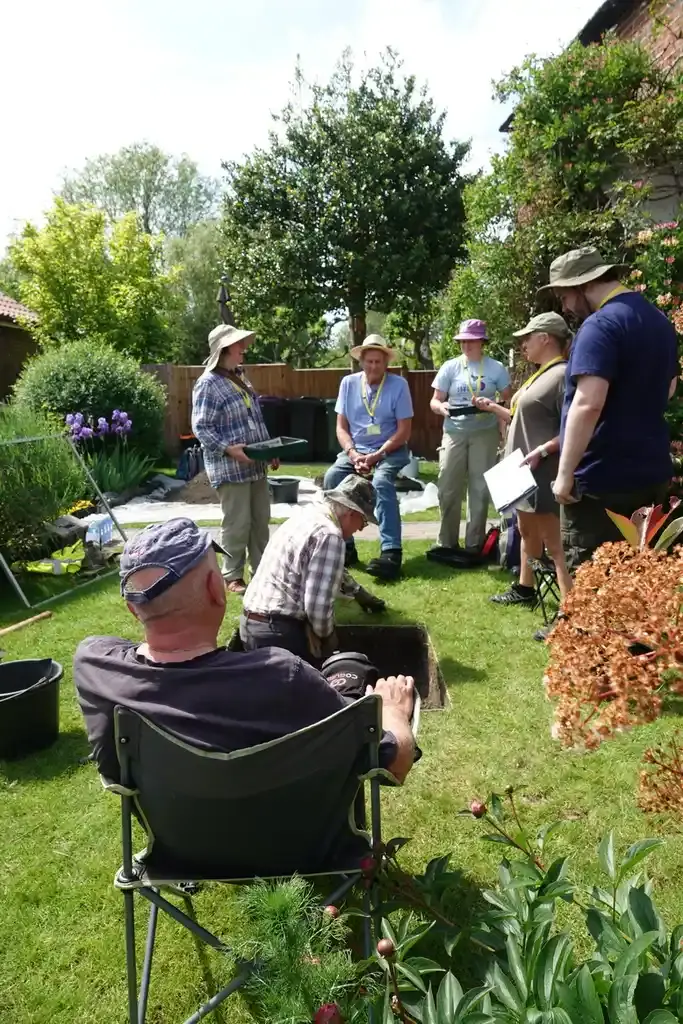
We dug as a team and as we uncovered the different layers I learned the appropriate
terminology and how to look at soil for the context recording we had to complete. The paperwork was a surprise and it did take me some effort to get my head around it all, but it was fascinating to see the test pit become a perfect 1m x 1m square and to see the layers appear and to be involved in recording the context, not only in writing, but also in technical drawings.
We found mostly Victorian sherds, glazed in a variety of colours, animal bones and some oyster shells. We were pleased to find some small pieces of medieval shell-tempered pottery, which we felt were residual. Finally, we came across a layer of medium sized random stones, likely to be Victorian. We all wanted to dig deeper, but we ran out of time and had to face the task of refilling the hole!
The whole experience was really enjoyable and I learnt so much in a friendly environment with so much information coming from people with huge amounts of experience.
Finds Processing - Jill
Day 1
Since most of the morning was spent in setting up the test pits and making sure that volunteers knew what to do, it was quite late before I hunted down the first tray and started work with Charles.

The householders, Dorothy and Ian, allowed us to set up in their front garden and were very helpful. Ian organised a hosepipe so we could easily change the water in the bowls.
Dorothy was very excited we were there and joined in enthusiastically. She also said we could borrow their parasol which was much appreciated.
After lunch, trays began arriving at a pace so we were kept busy. As the weather was so warm, the clean finds were left in the sun to dry. We were able to start bagging some of the finds that day. There were several trays left over by the end of the day, even though we didn’t leave until 4.45pm

Day 2
We were able to finish bagging the clean finds and process the left over trays before
more trays arrived. It was exciting to see what had been found and speculate on their age.
Jane came to look at some of the pottery and confirmed some of it was very early.
Day 3
Again we started by bagging the clean finds and were able to finish this before any more trays appeared. From our various visitors we learned that two pits were being shut down so I asked that any trays still with finds could be brought to us to be processed as soon as possible.

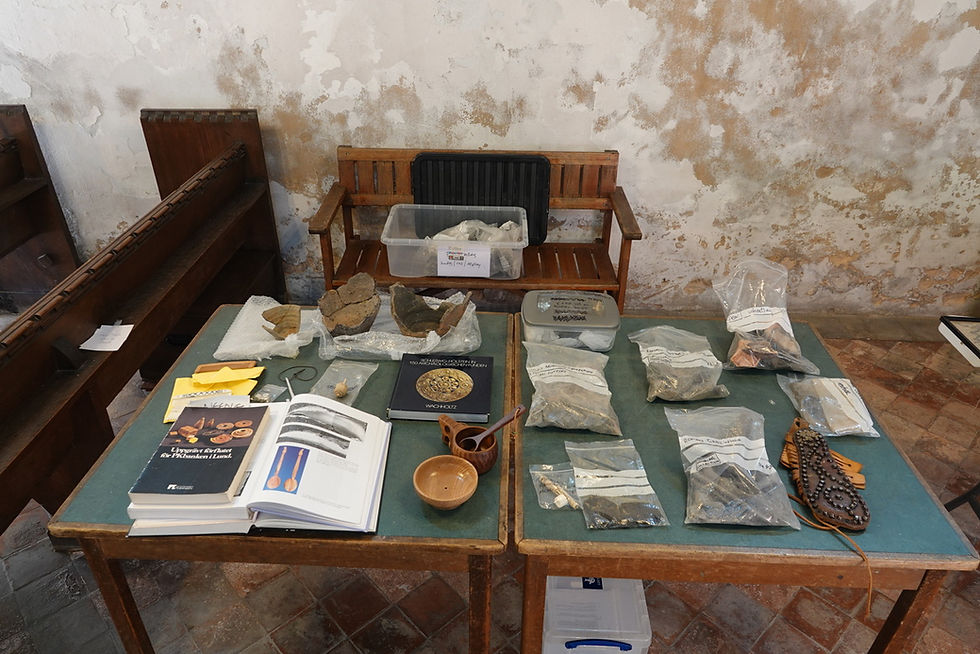
The worked bone was an exciting find and Brian’s Brick (well half brick!) was given a bag of its very own. We ate lunch early so we could keep working, which proved to be a good idea as a couple of late trays appeared. However, we managed to wash all the finds and only three damp finds trays were left over.

The good people from the test pits came to help move all the trays and tidy up, for which we were grateful.
I had an excellent weekend and would do it again in a heartbeat.

Comments